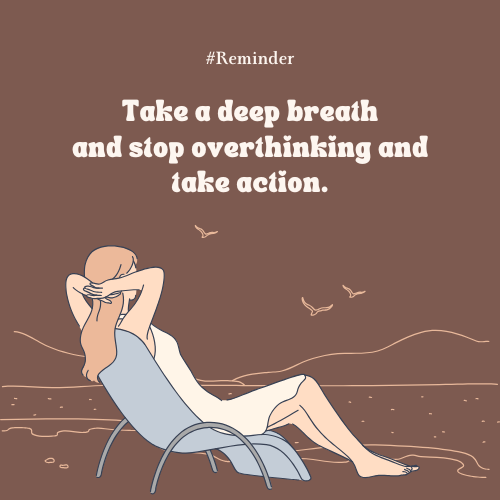
Overthinking is often mistaken to be productivity, however, it is actually a type of mental stagnation. The brain becomes stuck in a loop, it keeps going over the same thing again and again, it ruminates on past mistakes, it dramatizes worst, case scenarios, and it dissects every possible outcome until it feels that it is not possible to take any action. In most cases, overthinking is caused by fear of failure, fear of being judged, or fear of making the wrong choice. When the brain detects uncertainty, it attempts to shield the body by postponing the action, it persuades you that if you think more, then you will find the perfect solution. Nevertheless, clarity is not an outcome of more thinking, it is actually a consequence of making the next move. The more hours you spend locking yourself up in your own thoughts, the more it will seem that small tasks are getting heavier and heavier. The process of liberation is recognizing that you do not need certainty in order to take action, what you need is direction. Progress is made when you realize that taking imperfect action is safer and stronger than doing endless analysis.
The felicitous mode of procedure to impede inordinate cogitations is to transfer one's attention from the results to the deeds. Instead of wondering, "How could it possibly go wrong?" think, "What is the smallest step I can take right now?" Small operations have a soothing effect on the nervous system since they bring about movement and a sense of control. Often, just one sentence, ten minutes of studying, or sending one email is sufficient to break the cycle of overthinking. Additionally, the act of setting up definite limits for one's thoughts can be of assistance allowing oneself a certain amount of time for planning and then, upon the expiration of that time, committing to action. Overthinking is most intense in an unstructured mental space; hence, organization diminishes it. Another potent measure is the externalization of one's thoughts by putting them in writing. When worries are confined to one's head, they seem to be too much to bear; however, once they are written, they become feasible. Action is a source of confidence since, with each step completed, one is proven to be capable of handling discomfort. Confidence is not acquired through thought; rather it is acquired through action.
To keep on taking action regularly is something that needs self, trust, and not self, pressure. People who are overthinking are in most cases very much aware of themselves and are also sensitive. This means that these people do not need more criticism but rather they need a go, ahead to move forward in their imperfection. Switch the requirement for control with that of curiosity. Instead of questioning, "What if I fail?" you should be asking, "What can I learn by trying?" A mind like that takes the emotional part of the decision out and thus the step becomes a sort of discovery. Gradually, action alters the brain to be comfortable with being in motion rather than being stuck in thought. You start trusting yourself not because everything turns out well, but because you find out that you can adjust. The less you do, the more the noise becomes. Overthinking will go away when you choose to move forward rather than waiting for perfect conditions and decide to act rather than succumbing to fear. Action is not the removal of doubt; it is the decision to move forward notwithstanding the doubt, and if that decision is maintained every day, it is the one that creates the biggest impact.